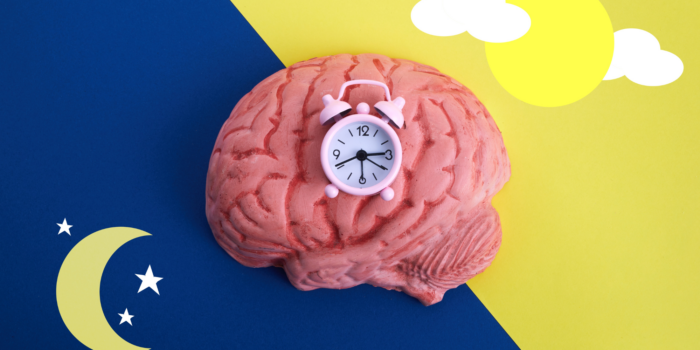
Your internal body clock can be linked to dementia
March 2nd, 2026It’s time to think about your circadian rhythm – your 24-hour internal body clock. Is your life erratic without structure or are you bodywise? A recent study has revealed that a weak body clock may be linked to cognitive decline and dementia.
A weak circadian rhythm can make your body less stable.
Your circadian rhythm is your body’s natural physiological timing system. It regulates functions such as hormone release, digestion, sleep, and body temperature. It’s like a conductor instructing an orchestra. The brain directs the body clock and responds to environmental cues. The clock itself is a tiny cluster of cells known as the SCN (suprachiasmatic nucleus), located in the hypothalamus section of the brain.
When your circadian rhythm is strong, it stays closely aligned with the daily cycle of light and dark, maintaining consistent patterns of sleep and activity. A weaker circadian rhythm makes the body less stable, more sensitive to disruption, and prone to shifting sleep patterns.
Shift workers are particularly vulnerable to a weakened circadian rhythm and may develop shift work sleep disorder (SWSD). Their bodies are working against the natural 24-hour cycle, causing circadian misalignment and, in some cases, reducing cognitive performance by up to 30%.
How do you know if you have a weak circadian rhythm?
A weakened circadian rhythm can occur at any stage of life. Parents of young children, for example, often experience chronically misaligned sleep-wake patterns. Sleepless nights can lead to extreme daytime sleepiness, insomnia, and reduced alertness.
Other symptoms of a weak body clock may include:
● Difficulty falling asleep
● Sleeping for too long or waking too early
● Persistent fatigue
● Mood changes
● A strong urge to nap during the day
Many of us experience these symptoms occasionally, but persistent disruption is not good for long-term health.
What the experts found out.
The study was published in the December edition of Neurology, the medical journal of the American Academy of Neurology.
Researchers followed 2,138 participants with an average age of 79. At the start of the study, none had dementia. Participants were 24% Black and 76% White. They wore activity monitors for 12 days to track rest and movement patterns.
The key measure was relative amplitude – the difference between a person’s most active and least active periods during the day. A higher relative amplitude indicates a stronger, more defined circadian rhythm.
Study author Wendy Wang, MPH, PhD, of the Peter O’Donnell Jr. School of Public Health at UT Southwestern Medical Center, explained:
“Changes in circadian rhythms happen with ageing, and evidence suggests that circadian rhythm disturbances may be a risk factor for neurodegenerative diseases like dementia.”
The study found that people with weaker or more fragmented activity rhythms, and those whose activity peaked later in the day, had an increased risk of developing dementia.
Read the full study here
How to strengthen your circadian rhythm
To support a stronger body clock and potentially reduce dementia risk:
● Maintain consistent daily routines – regularity is key
● Wake up at the same time every day, including weekends (occasional variations are fine)
● Get morning light exposure: within 15 minutes of waking, aim for 15-20 minutes of natural light. This helps reset your circadian rhythm, boosts energy, improves mood, and increases alertness. During winter, light therapy lamps can help, especially for people with Seasonal Affective Disorder (SAD)
● Reduce evening light exposure and create a calming bedtime routine
● Dim lights 2-3 hours before bed and keep your bedroom dark at night
● Aim for 7-9 hours of sleep per night
● Create an optimal sleep environment (comfortable temperature, good ventilation, suitable bedding) Should the dog really be on the bed? Oh but how you resist that little face?
● Wear comfortable sleepwear
● Limit screen use in the evening
● Avoid eating late; ideally, finish meals 2-4 hours before bedtime
● Limit evening stimulants such as caffeine, alcohol, nicotine, and high-sugar processed foods. A treat in moderation is fine now and then but it’s worth thinking twice before you open that box of chocolates and work your way through a bottle of wine watching a movie
● Reduce fluid intake 1-2 hours before bed to minimise night-time waking
● Avoid vigorous exercise within 1-2 hours of bedtime
● Manage stress through relaxation techniques such as journaling, reading, listening to calming music, or ‘beditation’
We hope these tips help you strengthen your internal body clock. Establishing a consistent sleep-wake cycle is one of the most effective ways to support long-term health.
To help manage fatigue and insomnia, we recommend our product Epitalon. It is designed to support healthy sleep cycles and overall wellbeing by helping regulate melatonin levels and supporting circadian rhythm balance.
References
https://my.clevelandclinic.org/health/diseases/12115-circadian-rhythm-disorders https://www.sciencedaily.com/releases/2026/01/260103155026.htm https://www.aan.com/PressRoom/home/PressRelease/5306 https://www.healthline.com/nutrition/17-tips-to-sleep-better https://pmc.ncbi.nlm.nih.gov/articles/PMC8832572/ https://www.nytimes.com/2023/12/19/well/eat/eating-late-night-health.html https://www.health.harvard.edu/staying-healthy/does-exerci



Download the latest FREE AGING MATTERS MAGAZINE
V3 issue 42 2023

- Advertisement -